A comprehensive guide to gemstone certification for nanhong agate buyers. Learn how to verify authenticity, understand Chinese national standards, and avoid costly certificate fraud.
Editor’s Note (April 2026): This guide covers major gemological laboratories serving the nanhong agate market, including NGTC (China), GIL (USA), and provincial-level institutions in Sichuan and Yunnan. All information has been verified against official sources. Certificate examples and verification links are current as of April 2026.
Why Certification Matters for Nanhong Agate
In today’s market, over 80% of nanhong agate products have undergone some form of artificial treatment—dyeing, resin injection, heat treatment, or acid washing. Without proper certification, buyers have no reliable way to distinguish natural stone from treated material.
A legitimate certificate provides:
- Independent verification of natural, untreated status
- Origin documentation (Kazakhstan vs. Chinese sources)
- Quality grading (color, pattern, clarity)
- Legal protection in case of disputes
- Resale value preservation
Critical: Not all certificates are created equal. This guide explains which laboratories to trust, how to verify authenticity, and what red flags to avoid.
Part 1: International & National Laboratories
GIL (Gem International Laboratories) — USA
Overview:
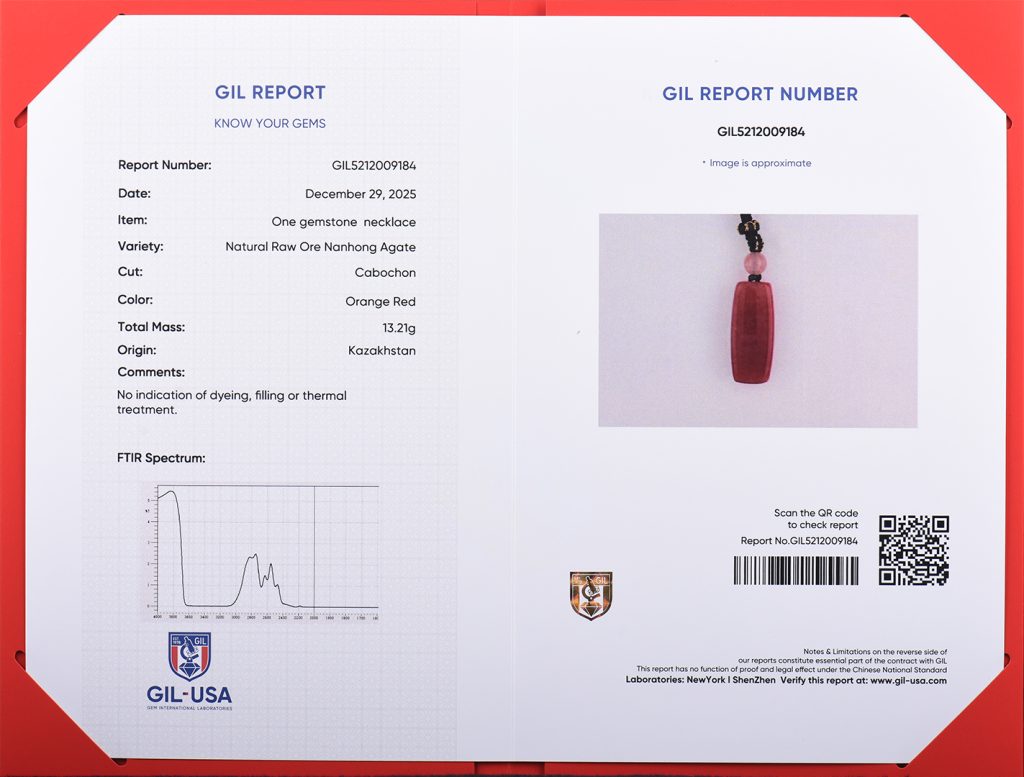
GIL is a US-based gemological laboratory with testing facilities in New York and Shenzhen. They provide certification services for the international gemstone trade, including nanhong agate.
GIL Certificate Features:
- Report Number: Unique identifier (e.g., GIL5212009170)
- Date of Issue: Testing date
- Item Description: Type of jewelry or loose stone
- Variety: “Natural Raw Ore Nanhong Agate” or similar
- Cut: Carving, cabochon, bead, etc.
- Color: Specific color description (e.g., “Orange Red”)
- Total Mass: Weight in grams (e.g., 31.284g)
- Origin: Geographic source (e.g., “Kazakhstan”)
- Comments: Treatment disclosure (critical section)
- FTIR Spectrum: Infrared spectroscopy data
- QR Code: For online verification
- Photo: Actual stone photograph
GIL Treatment Disclosure:
Look for this exact wording in the Comments section:
“No indication of dyeing, filling or thermal treatment.”
This confirms the stone is 100% natural and untreated.
Verification:
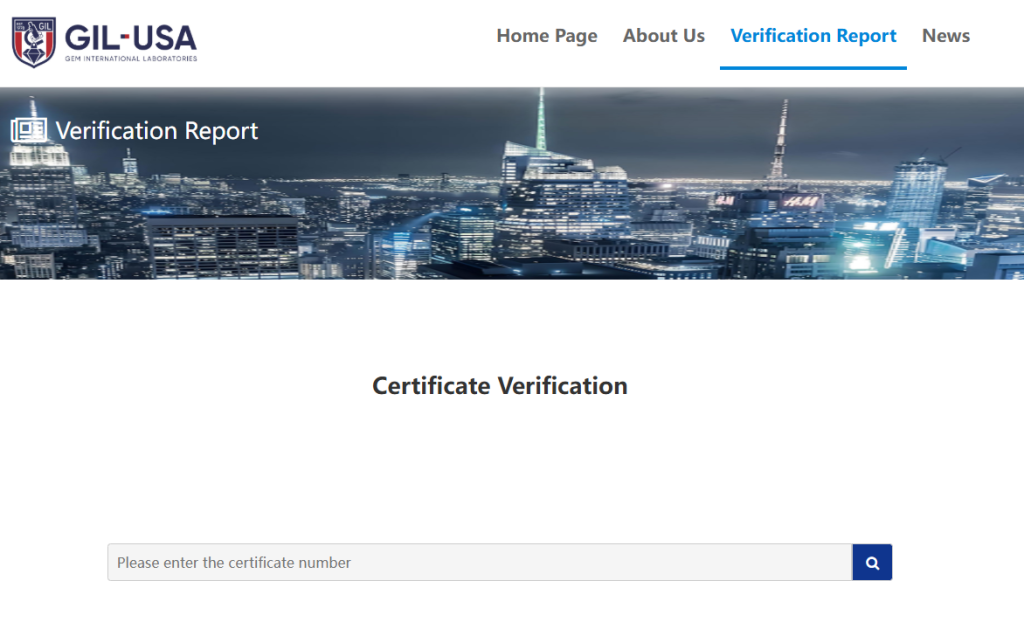
- Website: www.gil-usa.com
- Verify Report: Enter report number on homepage
- QR Code: Scan with smartphone to access digital report
- Laboratories: New York | Shenzhen
GIL Certificate Example:
Report Number: GIL5212009170
Date: December 29, 2025
Variety: Natural Raw Ore Nanhong Agate
Origin: Kazakhstan
Comments: No indication of dyeing, filling or thermal treatment.
When GIL Certification Is Used:
- Export markets (US, Europe, Southeast Asia)
- High-value collector pieces
- International auction houses
- Premium jewelry brands
Pros:
✅ International recognition
✅ Detailed spectroscopy data (FTIR)
✅ Bilingual reports (English + Chinese)
✅ Shenzhen lab for faster China turnaround
Cons:
❌ Higher cost than domestic-only certificates
❌ Less familiar to Chinese domestic buyers
NGTC (National Gemstone Testing Center) — China
Overview:
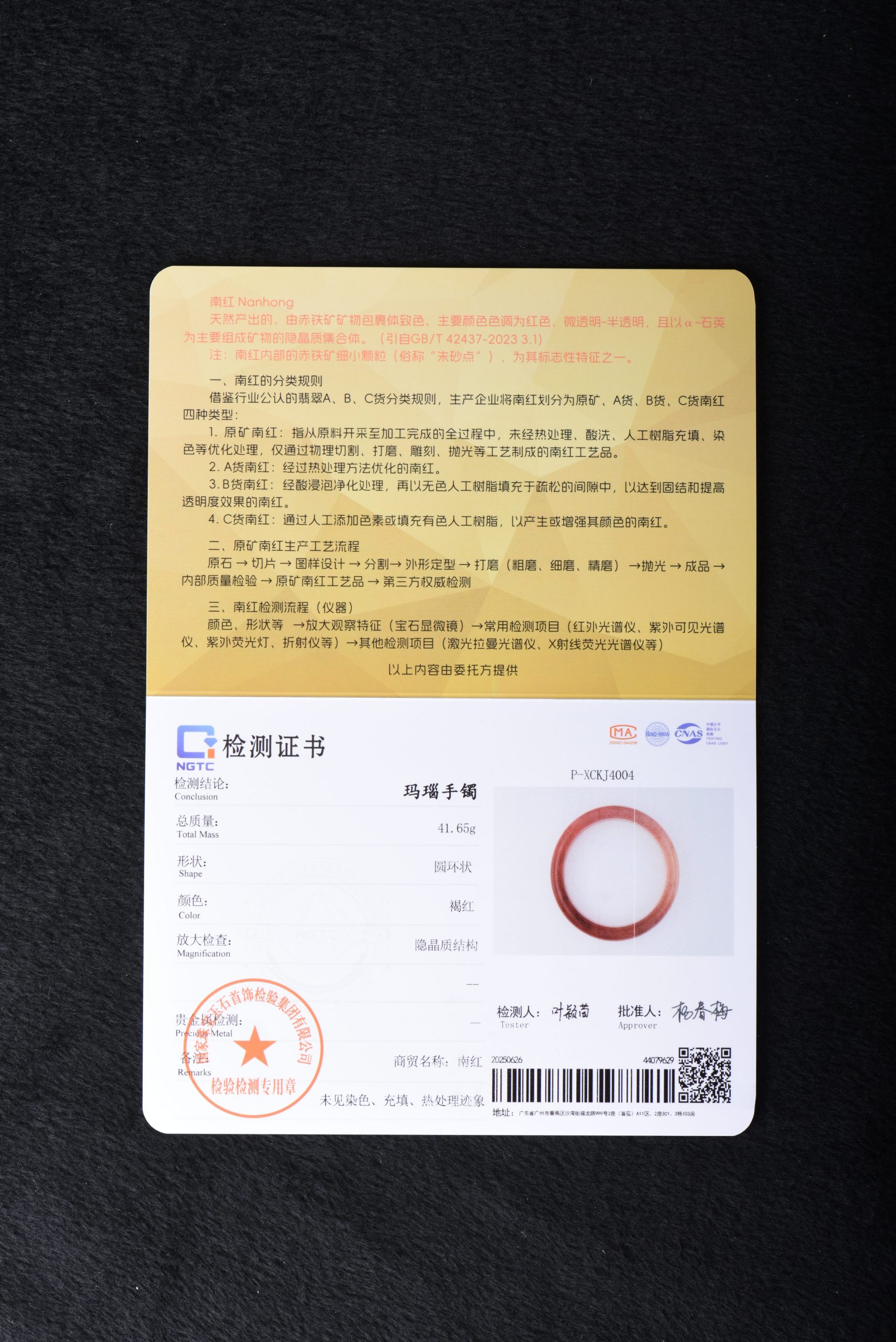
NGTC is China’s most authoritative gemological laboratory, established in 1993 under the Ministry of Natural Resources. It is the gold standard for nanhong agate certification in the Chinese market.
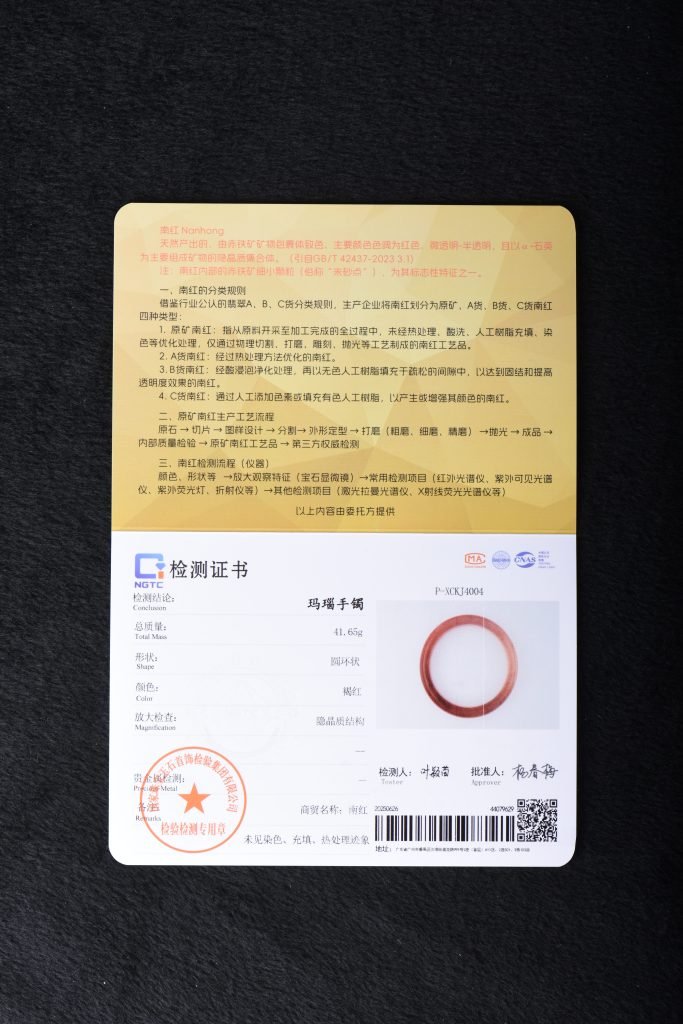
NGTC Certificate Features:
- 证书编号 (Certificate Number): 14-digit unique ID
- 检测日期 (Testing Date): Date of certification
- 样品照片 (Photo): Actual stone photograph
- 名称 (Name): Standardized gemstone name
- 总质量 (Total Mass): Weight in grams
- 产地 (Origin): Geographic source (when determinable)
- 鉴定结果 (Result): “天然玛瑙” (Natural Agate) or “处理” (Treated)
- 备注 (Comments): Treatment details if applicable
- 二维码 (QR Code): For online verification
- 防伪标识 (Security Mark): Hologram or watermark
NGTC Treatment Disclosure:
NGTC uses standardized terminology:
- 天然玛瑙 (Natural Agate): No treatment detected
- 处理玛瑙 (Treated Agate): Must specify treatment type:
- 染色 (Dyed)
- 充填 (Filled/Resin-injected)
- 热处理 (Heat-treated)
Verification:
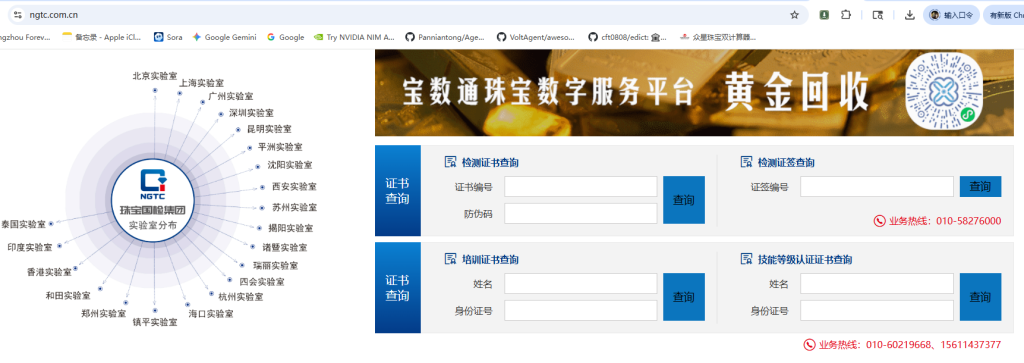
- Website: www.ngtc.com.cn
- 证书查询 (Certificate Lookup): Available on homepage
- QR Code: Scan with WeChat or smartphone
- Phone: 400-677-1188 (national hotline)
NGTC Testing Standards:
NGTC follows Chinese national standards:
- GB/T 16552-2017《珠宝玉石 名称》
- GB/T 16553-2017《珠宝玉石 鉴定》
- GB/T 23885-2009《翡翠玉石分级》
When NGTC Certification Is Used:
- Domestic Chinese market sales
- E-commerce platforms (Tmall, JD, Douyin)
- Physical retail stores
- Auction houses in China
Pros:
✅ Most recognized in China
✅ Government-backed authority
✅ Strict testing standards
✅ Legal admissibility in disputes
Cons:
❌ Chinese-language reports only
❌ Longer turnaround (5-7 business days)
❌ Higher cost for bulk testing
Part 2: Provincial-Level Laboratories
Sichuan Provincial Gemstone Testing Center
Overview:
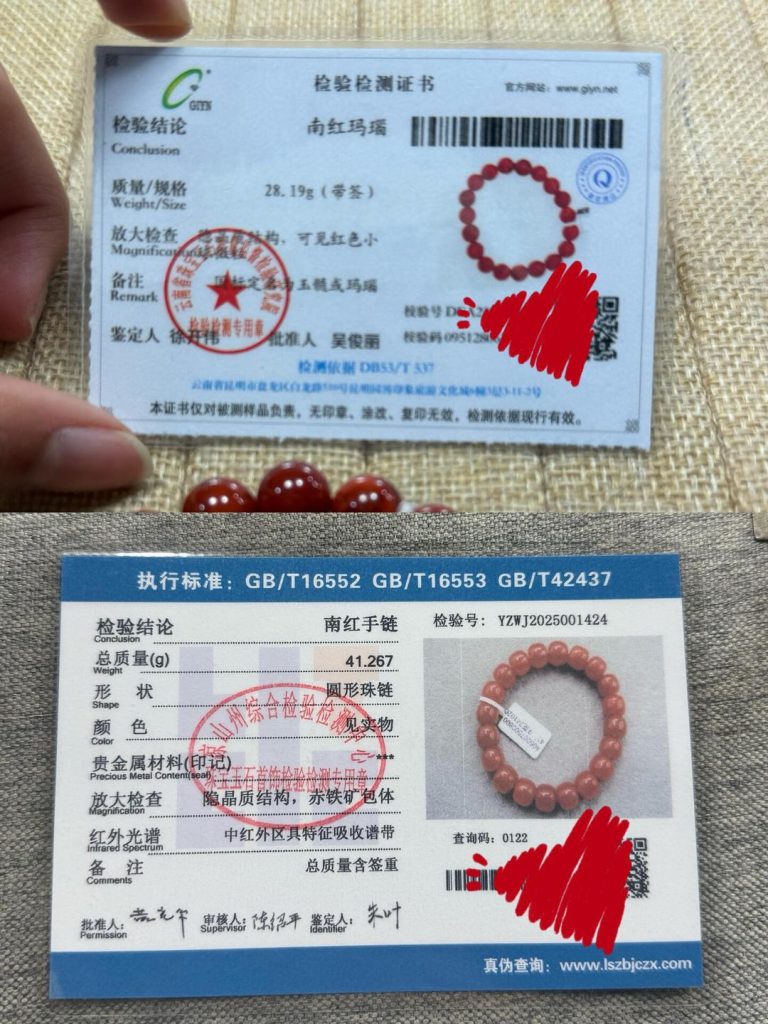
Sichuan Province is one of China’s traditional nanhong sources (Liangshan region). The provincial testing center has extensive experience with nanhong agate identification.
Full Name: 四川省珠宝玉石质量监督检验站 (Sichuan Provincial Jewelry & Gemstone Quality Supervision Testing Station)
Location: Chengdu, Sichuan Province
Specialization:
- Liangshan nanhong agate (四川凉山南红)
- Regional origin identification
- Traditional carving authentication
Certificate Features:
- CMA Mark: China Metrology Accreditation
- CAL Mark: China Accredited Laboratory
- CNAS Mark: China National Accreditation Service
- 省级标识 (Provincial Mark): Sichuan-specific security features
Verification:
- Website: www.sczjjc.com (verify current URL)
- Phone: +86-28-8523-XXXX (contact for current number)
- Address: 成都市人民南路四段 XX 号
When Used:
- Sichuan nanhong transactions
- Regional collector market
- Local jewelry retailers
Pros:
✅ Deep expertise in Sichuan nanhong
✅ Faster turnaround for local sellers
✅ Lower cost than NGTC
Cons:
❌ Limited recognition outside Sichuan
❌ Less stringent than NGTC
❌ Website verification may be limited
Yunnan Provincial Gemstone Testing Center
Overview:
Yunnan Province (particularly Baoshan region) is another historic nanhong source. The provincial laboratory specializes in Yunnan nanhong identification.
Full Name: 云南省珠宝玉石质量监督检验研究院 (Yunnan Provincial Jewelry & Gemstone Quality Supervision Testing and Research Institute)
Location: Kunming, Yunnan Province
Specialization:
- Baoshan nanhong agate (云南保山南红)
- Old mine material authentication
- Traditional carving appraisal
Certificate Features:
- CMA/CAL/CNAS: Triple accreditation marks
- 省级标识 (Provincial Mark): Yunnan-specific features
- 产地标识 (Origin Mark): “云南保山” when determinable
Verification:
- Website: https://www.giyn.net/ (verify current URL)
- Phone: +86-0871-63166319 (contact for current number)
- Address: 云南·昆明市盘龙区东风东路汇都国际D幢11、12楼
When Used:
- Yunnan nanhong transactions
- Regional collector market
- Antique nanhong authentication
Pros:
✅ Expertise in Baoshan nanhong characteristics
✅ Recognition in Southwest China
✅ Competitive pricing
Cons:
❌ Limited national recognition
❌ Less experience with Kazakhstan material
❌ Verification systems vary
Other Provincial Laboratories
Guangdong Provincial Gemstone Testing Center
- Location: Guangzhou
- Specialization: Jewelry manufacturing hub testing
- Common for: Finished jewelry certification
Shanghai Gemstone Testing Center
- Location: Shanghai
- Specialization: High-end collector pieces
- Common for: Auction house pre-sale authentication
Beijing Gemstone Testing Center
- Location: Beijing
- Specialization: Government procurement standards
- Common for: Official gifts and state transactions
Part 3: Chinese National Standards for Nanhong Agate
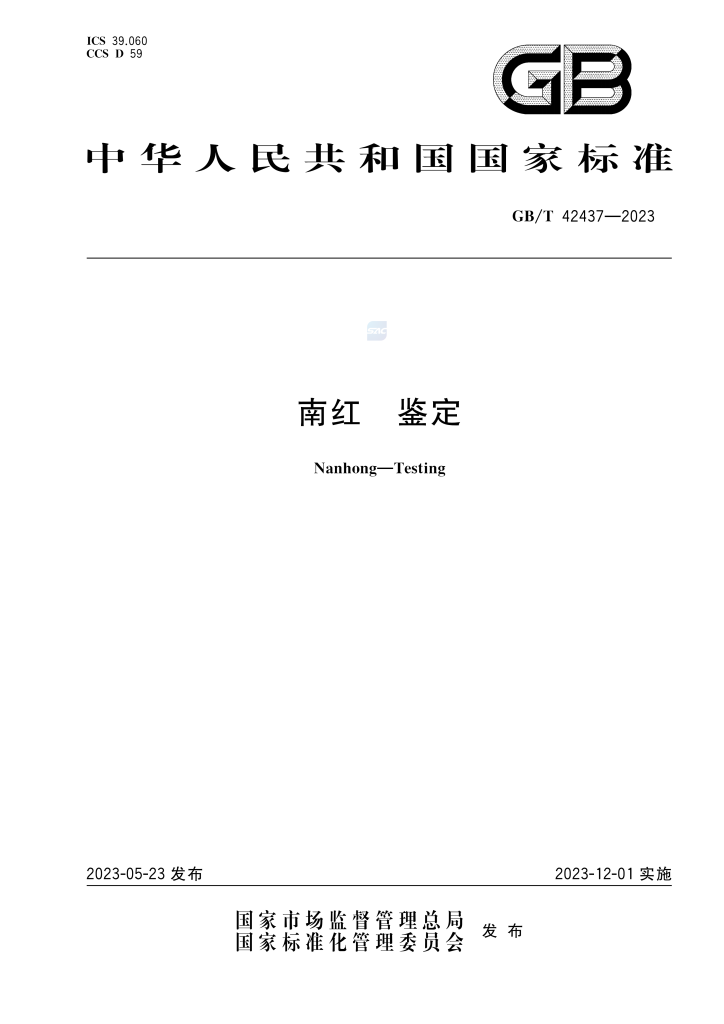
GB/T 42437-2023 3.1《南红玛瑙》(Nanhong Agate) — Primary Standard
Purpose: This is the dedicated national standard for nanhong agate, released in 2023. It provides specific definitions, classification, and testing methods for nanhong agate.
Release Date: 2023-03-17
Implementation Date: 2023-10-01
Issuing Authority: 国家市场监督管理总局 (State Administration for Market Regulation) + 国家标准化管理委员会 (Standardization Administration of China)
Key Provisions (Section 3.1):
- Definition (定义):
南红玛瑙 nanhong agate
主要组成矿物为红色玉髓(carnelian)的玛瑙。主要致色元素为铁 (Fe)。
Nanhong agate is agate whose main constituent mineral is red chalcedony (carnelian). The main coloring element is iron (Fe).
- Standard Name:
- 中文: “南红玛瑙” (officially recognized trade name)
- 英文: “Nanhong Agate”
- 矿物学名称: “红色玉髓玛瑙” (Red Chalcedony Agate)
- Classification (分类):
- 按产状分 (By Occurrence):
- 山料 (Mountain Material) — mined from primary deposits
- 籽料 (Seed Material) — water-worn secondary deposits
- 按颜色分 (By Color):
- 锦红 (Jin Hong) — deep, saturated red
- 柿子红 (Persimmon Red) — orange-red
- 樱桃红 (Cherry Red) — bright red with pink undertones
- 玫瑰红 (Rose Red) — pinkish-red with purple hints
- 火焰纹 (Flame Pattern) — red-white interplay
- Quality Grading (质量分级):
- 颜色 (Color): Saturation, tone, evenness
- 质地 (Texture): Fineness, compactness
- 净度 (Clarity): Inclusions, cracks, impurities
- 工艺 (Craftsmanship): Cut quality, polish, symmetry
- Testing Methods (检测方法):
- 折射率 (Refractive Index): 1.53-1.54 (point method)
- 密度 (Density): 2.6-2.7 g/cm³ (hydrostatic method)
- 光谱分析 (Spectroscopy): FTIR for treatment detection
- 放大检查 (Magnification): 10x-60x microscope examination
- Treatment Disclosure (优化处理披露):
- 天然 (Natural): No treatment detected
- 染色 (Dyed): Artificial coloration
- 充填 (Filled): Resin/polymer impregnation
- 热处理 (Heat-treated): Thermal enhancement
Example Certificate Language (per GB/T 42437-2023):
名称:南红玛瑙 (Nanhong Agate)
产地:哈萨克斯坦 (Origin: Kazakhstan)
产状:山料 (Occurrence: Mountain Material)
颜色:柿子红 (Color: Persimmon Red)
处理:无 (Treatment: None)
标准:GB/T 42437-2023 3.1 (Standard: GB/T 42437-2023 3.1)
GB/T 16552-2017《珠宝玉石 名称》(Jewelry and Gemstones — Nomenclature)
Purpose: Standardizes gemstone naming conventions across all jewelry categories.
Relationship to GB/T 42437-2023:
- GB/T 16552 provides general naming rules for all gemstones
- GB/T 42437-2023 provides specific rules for nanhong agate
- When both apply, GB/T 42437-2023 takes precedence for nanhong
Key Provisions for Nanhong:
- Standard Name: “南红玛瑙” is now officially recognized (per 2023 standard)
- Previously: “玛瑙” or “玉髓” only
- Currently: “南红玛瑙” is acceptable on certificates
- Origin Disclosure:
- Origin can be stated if verifiable (e.g., “Kazakhstan”, “Sichuan”, “Yunnan”)
- Origin is optional unless specifically requested by customer
- Treatment Disclosure:
- Must clearly state if stone is treated
- Treatment type must be specified (dyeing, filling, heating)
Example Certificate Language:
名称:南红玛瑙 (Nanhong Agate)
产地:哈萨克斯坦 (Origin: Kazakhstan)
处理:无 (Treatment: None)
GB/T 16553-2017《珠宝玉石 鉴定》(Jewelry and Gemstones — Identification)
Purpose: Defines general testing methods and criteria for gemstone identification.
Testing Methods for Nanhong (aligned with GB/T 42437-2023):
- Visual Examination (肉眼观察)
- Color distribution analysis
- Pattern recognition (flame patterns, ice layers)
- Surface texture assessment
- Refractive Index (折射率测试)
- Natural nanhong: 1.53-1.54
- Measured using refractometer (point method)
- Per GB/T 42437-2023 Section 5.2.1
- Specific Gravity (比重测试)
- Natural nanhong: 2.6-2.7 g/cm³
- Measured using hydrostatic balance
- Per GB/T 42437-2023 Section 5.2.2
- Spectroscopy (光谱分析)
- FTIR (Fourier Transform Infrared Spectroscopy)
- Detects treatment residues (resin, dye)
- GIL and NGTC both use this method
- Per GB/T 42437-2023 Section 5.2.3
- Microscopic Examination (显微镜检查)
- 10x-60x magnification
- Identifies cryptocrystalline structure
- Detects dye concentration in fractures
- Per GB/T 42437-2023 Section 5.2.4
- UV Fluorescence (紫外荧光)
- Natural nanhong: Weak to moderate fluorescence
- Treated stone: Abnormal fluorescence patterns
Treatment Detection Criteria (per GB/T 42437-2023 Section 6):
| Treatment Type | Detection Method | Indicator |
|---|---|---|
| Dyeing | FTIR + Microscope | Dye concentration in cracks |
| Resin Filling | FTIR + UV | Polymer absorption peaks |
| Heat Treatment | Microscope + Color | Surface crazing, color alteration |
| Acid Washing | Microscope | Etched surface texture |
Note on Standard Hierarchy
For Nanhong Agate Certification:
- Primary Standard: GB/T 42437-2023 3.1《南红玛瑙》
- Dedicated standard for nanhong
- Takes precedence in all nanhong-specific matters
- Released 2023, implemented October 2023
- Supporting Standards:
- GB/T 16552-2017《珠宝玉石 名称》— General naming conventions
- GB/T 16553-2017《珠宝玉石 鉴定》— General testing methods
- Used when GB/T 42437-2023 doesn’t cover specific details
- Certificate Requirements:
- Should reference GB/T 42437-2023 3.1 as primary standard
- May also reference GB/T 16552 and GB/T 16553 for supplementary methods
- NGTC and GIL both comply with GB/T 42437-2023
Important: Certificates issued after October 2023 should reference GB/T 42437-2023. Older certificates may reference only GB/T 16552/16553, which is acceptable for vintage pieces but less specific.
Part 4: How to Read a Nanhong Agate Certificate
Essential Information Checklist
Must-Have Elements:
- ✅ Certificate Number (unique, verifiable)
- ✅ Testing Date (within 2-3 years preferred)
- ✅ Sample Photo (matches actual stone)
- ✅ Weight/Mass (in grams, precise to 0.01g)
- ✅ Gemstone Name (standardized terminology)
- ✅ Treatment Disclosure (critical section)
- ✅ Laboratory Name & Logo (recognized institution)
- ✅ Security Features (QR code, hologram, watermark)
- ✅ Testing Standards Referenced (GB/T numbers)
- ✅ Authorized Signature (certifier’s name/seal)
Critical Section: Treatment Disclosure
Natural Stone Language (Good):
- “天然玛瑙” (Natural Agate)
- “No indication of treatment”
- “No indication of dyeing, filling or thermal treatment”
- “天然南红玛瑙” (Natural Nanhong Agate)
Treated Stone Language (Warning):
- “处理玛瑙” (Treated Agate)
- “染色” (Dyed)
- “充填” (Filled/Resin-injected)
- “热处理” (Heat-treated)
- “优化” (Enhanced — euphemism for treatment)
Ambiguous Language (Red Flag):
- “天然玛瑙(优化)” — Vague enhancement disclosure
- “特殊处理” — “Special treatment” without specifics
- No treatment section at all — Missing critical info
Verification Steps
Step 1: Check Certificate Number
- Go to laboratory’s official website
- Enter certificate number in verification portal
- Confirm all details match your stone
Step 2: Scan QR Code
- Use smartphone camera or WeChat
- Should redirect to official verification page
- Beware of fake QR codes linking to clone websites
Step 3: Verify Security Features
- Hologram should show 3D effect when tilted
- Watermark visible under bright light
- Microprinting readable under magnification
Step 4: Cross-Check Weight
- Weigh the stone yourself
- Should match certificate within ±0.02g
- Significant discrepancy = red flag
Step 5: Compare Photo
- Certificate photo should match your stone exactly
- Look for unique patterns, inclusions, color distribution
- Stock photo or generic image = fake certificate
Part 5: Common Certificate Fraud Schemes
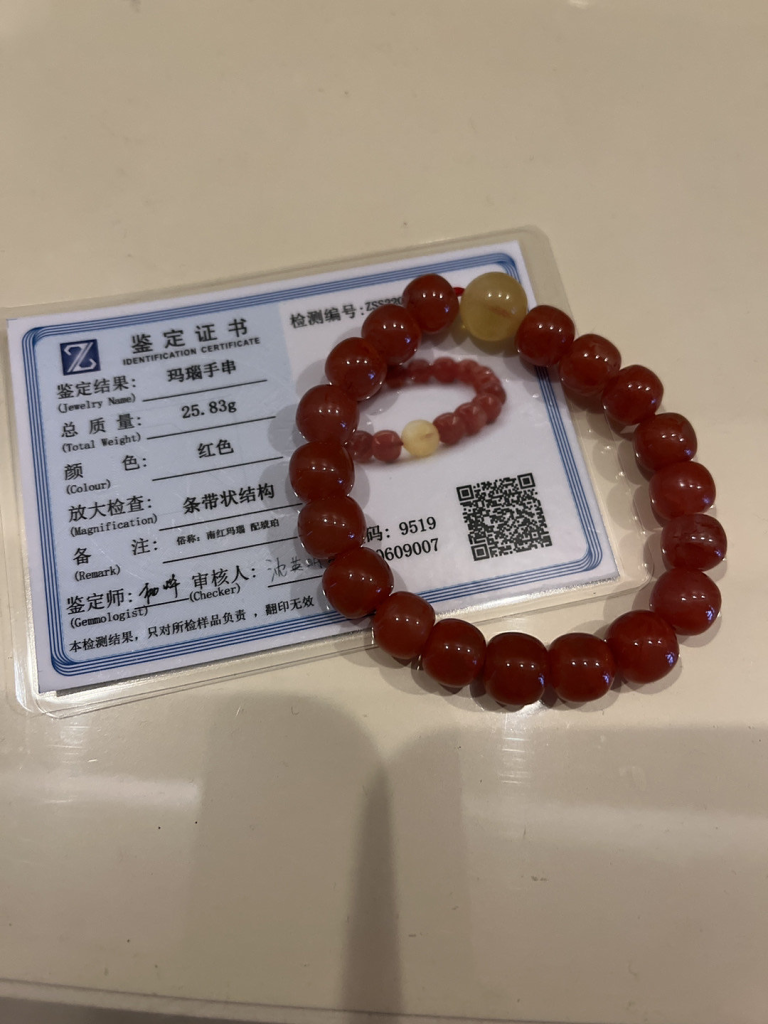
1. Fake Certificates (假证书)
Characteristics:
- Copied from real certificates with altered numbers
- Poor print quality
- Misspelled laboratory names
- Invalid certificate numbers
How to Avoid:
- Always verify online
- Check print quality and security features
- Contact laboratory directly if suspicious
2. “Wild Chicken” Laboratories (野鸡机构)
Characteristics:
- Unaccredited laboratories with official-sounding names
- Issue certificates for any stone (no real testing)
- Certificates look professional but meaningless
- Often charge per certificate, not per test
Red Flags:
- Laboratory name includes “International,” “National,” but no .gov or .edu domain
- No physical address or verifiable contact info
- Certificate issued same-day without proper testing time
- Price suspiciously low (¥10-20 per certificate)
How to Avoid:
- Stick to NGTC, GIL, or established provincial labs
- Verify laboratory accreditation (CMA/CAL/CNAS)
- Check industry reputation and reviews
3. Certificate Swapping (套证)
Characteristics:
- Real certificate paired with fake/treated stone
- Certificate from one stone used for multiple stones
- Weight matches but other characteristics don’t
How to Detect:
- Compare photo carefully (patterns must match)
- Check all characteristics (color, clarity, cut)
- Verify certificate number independently
4. Expired Certificates (过期证书)
Issue:
- Certificates older than 3-5 years may not reflect current condition
- Stone may have been damaged or altered since certification
- Treatment detection methods improve over time
Best Practice:
- Prefer certificates issued within 2-3 years
- Re-certify high-value pieces before resale
- Update certificates if stone is re-cut or re-polished
5. Partial Disclosure (部分披露)
Characteristics:
- Certificate states “natural” but omits minor treatments
- “Minor dyeing” or “light filling” not disclosed
- Relies on buyer not understanding technical terms
How to Avoid:
- Read entire certificate carefully
- Look for any mention of “treatment,” “enhancement,” or “optimization”
- Ask for written clarification if uncertain
Part 6: Forever Star Jewelry Certification Standards
Our Certification Commitment
Forever Star Jewelry provides dual certification for all Kazakhstan natural nanhong agate products:
1. GIL Certificate (International)
- Issued by Gem International Laboratories (USA/Shenzhen)
- Includes FTIR spectroscopy data
- English + Chinese bilingual report
- Online verification at www.gil-usa.com
Sample GIL Certificate Language:
Report Number: GIL5212009170
Variety: Natural Raw Ore Nanhong Agate
Origin: Kazakhstan
Comments: No indication of dyeing, filling or thermal treatment.
FTIR Spectrum: Included
2. NGTC Certificate (Domestic)
- Issued by National Gemstone Testing Center (China)
- Government-backed authority
- Chinese-language report with security features
- Online verification at www.ngtc.com.cn
Sample NGTC Certificate Language:
证书编号:NGTC202604XXXX
名称:天然玛瑙
产地:哈萨克斯坦
处理:无
Why Dual Certification?
For International Buyers:
- GIL certificate provides familiar, English-language documentation
- FTIR data offers scientific proof of natural status
- Easier resale in Western markets
For Domestic Buyers:
- NGTC certificate is legally recognized in China
- E-commerce platforms require NGTC for listing
- Stronger consumer protection under Chinese law
For All Buyers:
- Two independent laboratories = double verification
- Reduces risk of certificate fraud
- Maximizes resale value and liquidity
Our Certification Process
Step 1: Raw Material Testing
- Bulk ore samples sent to NGTC/GIL before processing
- Confirms natural status at source
- Identifies any treatment needs (we reject treated material)
Step 2: Finished Product Testing
- Each finished piece individually certified
- Photo, weight, and characteristics documented
- Certificate number assigned and recorded
Step 3: Quality Control
- Batch sampling for consistency
- Random third-party re-testing
- Customer feedback monitoring
Step 4: Certificate Delivery
- Physical certificate included with product
- Digital copy available via email/WeChat
- Verification instructions provided
Certificate Verification Support
We Provide:
- Step-by-step verification guide (this document)
- Direct links to NGTC and GIL verification portals
- Customer service support for verification questions
- Re-certification service if certificate is lost/damaged
Contact Us:
- Email: certification@foreverstarjewelry.com
- WeChat: ForeverStarJewelry
- Phone: +86-20-XXXX-XXXX
Part 7: Quick Reference Guide
Certificate Verification Checklist
Before Purchase:
- [ ] Certificate from recognized laboratory (NGTC, GIL, provincial)
- [ ] Certificate number visible and verifiable
- [ ] Treatment disclosure clearly states “natural” or “no treatment”
- [ ] Weight matches actual stone (±0.02g)
- [ ] Photo matches actual stone
- [ ] Certificate issued within 2-3 years
- [ ] Security features present (QR code, hologram)
After Purchase:
- [ ] Verify certificate number on laboratory website
- [ ] Scan QR code and confirm it links to official site
- [ ] Weigh stone and compare to certificate
- [ ] Compare stone characteristics to certificate description
- [ ] Save digital copy of certificate for records
Laboratory Comparison Table
| Laboratory | Recognition | Language | Turnaround | Cost | Best For |
|---|---|---|---|---|---|
| NGTC | ⭐⭐⭐⭐⭐ | Chinese | 5-7 days | ¥¥¥ | Domestic sales, legal protection |
| GIL | ⭐⭐⭐⭐ | Bilingual | 3-5 days | ¥¥¥¥ | International sales, FTIR data |
| Sichuan Provincial | ⭐⭐⭐ | Chinese | 2-3 days | ¥¥ | Sichuan nanhong, local market |
| Yunnan Provincial | ⭐⭐⭐ | Chinese | 2-3 days | ¥¥ | Baoshan nanhong, antique pieces |
| Guangdong Provincial | ⭐⭐⭐ | Chinese | 2-3 days | ¥¥ | Finished jewelry, export hub |
Rating: ⭐⭐⭐⭐⭐ = Highest recognition | ¥¥¥¥ = Highest cost
Red Flags Summary
🚩 Avoid If:
- No certificate provided
- Certificate from unknown laboratory
- Treatment section missing or vague
- Certificate number doesn’t verify online
- QR code links to suspicious website
- Weight discrepancy >0.05g
- Photo doesn’t match stone
- Certificate older than 5 years
- Price too good to be true
✅ Safe If:
- NGTC or GIL certificate included
- Certificate verifies online
- Clear “no treatment” disclosure
- All security features present
- Weight and photo match
- Certificate recent (within 2-3 years)
- Seller provides verification support
Conclusion: Protecting Your Investment
Nanhong agate certification is not just paperwork—it’s your legal protection, quality guarantee, and resale insurance. Here’s what to remember:
Key Takeaways:
- Always demand certification from recognized laboratories (NGTC, GIL, or established provincial labs)
- Verify certificates online before completing purchase—don’t trust paper alone
- Understand treatment disclosure—”Natural” means untreated; any enhancement must be disclosed
- Know the standards—GB/T 16552 and GB/T 16553 define legal requirements
- Dual certification adds value—Both GIL and NGTC provide maximum protection
- Beware of fraud—Fake certificates, wild chicken labs, and certificate swapping are common
- Forever Star commitment—All products include GIL + NGTC dual certification with full verification support
Final Advice:
If a seller hesitates to provide certification, or if the certificate seems suspicious, walk away. The small cost savings aren’t worth the risk of buying treated or fake material. Legitimate sellers welcome verification and stand behind their certificates.
For high-value purchases (¥10,000+), consider independent re-testing at your local NGTC branch. The ¥200-500 testing fee is cheap insurance against a costly mistake.
Appendix: Verification Links & Contact Information
NGTC (National Gemstone Testing Center)
- Website: https://www.ngtc.com.cn/
- Certificate Lookup: Homepage → 证书查询
- Hotline: 020-84733922
- Address: 广东省广州市番禺区沙湾街福龙路999号2座(首层)A11区、2座301、3栋103房
GIL (Gem International Laboratories)
- Website: http://gil-usa.com/
- Verify Report: Homepage → Verify
- Laboratories: New York | Shenzhen
- Shenzhen Address: No. 3008, Taibai Road, Dongxiao Street, Luohu District, Shenzhen, Yuehai T2 Office Building 2104. 深圳市罗湖区东晓街道太白路3008号粤海T2办公楼2104室。
Industry Resources
- China National Gold Group: www.chinagoldgroup.com
- Gemological Association of China: www.gac.edu.cn
- Ministry of Natural Resources: www.mnr.gov.cn