GIA research reveals how heat treatment, dyeing, and resin injection affect nanhong agate value. Learn why untreated stone commands 5-10x higher prices and how to protect your investment.
Editor’s Note (April 2026): This guide is based on gemological research from GIA (Gemological Institute of America) and NGTC (National Gemstone Testing Center), including laboratory analysis of treated nanhong agate specimens. Information has been verified against current industry standards. Last updated: April 1, 2026. For high-value purchases, always request independent laboratory certification.
Introduction: The $52,000 Question
In March 2025, a single flame pattern nanhong cabochon sold for $52,000 at a Hong Kong auction.
The stone weighed just 12.3 carats.
That’s $4,227 per carat — more than most diamonds, competing with fine colored gemstones like ruby and sapphire.
What made this particular piece so valuable?
Three words: Natural. Untreated. Certified.
But here’s the uncomfortable truth: That $52,000 stone is part of a tiny minority.
According to NGTC’s (National Gemstone Testing Center) 2025 annual report:
Over 80% of nanhong agate submitted for testing showed indications of treatment.
This means the vast majority of nanhong agate on the market has been artificially enhanced through:
- Heat treatment — altering color through controlled heating
- Dyeing — adding artificial color through chemical immersion
- Resin injection — filling fractures with polymer materials
- Acid washing — removing impurities through chemical treatment
Why does this matter?
Because the value difference is staggering:
| Treatment Type | Value Retention | Price Impact |
|---|---|---|
| Natural (untreated) | 100% | Baseline |
| Heat treated | 50-70% | -30-50% |
| Resin injected | 30-50% | -50-70% |
| Dyed | 10-30% | -70-90% |
Translation: A treated nanhong piece worth $100 today might be worth $10-50 in resale. A natural piece maintains or appreciates in value.
This guide reveals:
- 4 common treatment methods — how they work and why they’re used
- GIA’s breakthrough research — scientific methods to detect treatments
- 7 identification techniques — from simple home tests to laboratory analysis
- Investment protection strategies — how to avoid overpaying for treated material
Whether you’re a collector, jewelry designer, or investor, understanding the natural vs treated distinction is the single most important factor in protecting your nanhong agate investment.
Section 1: What Makes Nanhong Agate Valuable?
1.1 Historical and Cultural Significance
Nanhong agate has been prized in Chinese culture for over 2,000 years.
Historical Context:
- Han Dynasty (206 BCE – 220 CE): Nanhong used in royal jewelry and ceremonial objects
- Qing Dynasty (1644-1912): Known as “Chi Yu” (赤玉,Red Jade), reserved for imperial use
- Modern Era: Recognized as one of China’s “Four Famous Jades”
This historical pedigree creates sustained collector demand that transcends temporary market trends.
1.2 Scarcity Drives Value
Supply Constraints:
Chinese Mining Restrictions (2018-2020):
- Sichuan and Yunnan provinces implemented environmental mining bans
- Legal nanhong supply from China dropped by 70-80%
- Existing stock became increasingly valuable
Kazakhstan Production Limits:
- Only a few active mining operations
- Gem-grade material represents 15-20% of total ore extracted
- No new major deposits discovered since 2015
Quality Distribution:
| Grade | Percentage of Production |
|---|---|
| Gem-grade (any quality) | 15-20% |
| Flame pattern (any grade) | 3-5% of gem-grade |
| AAA grade flame pattern | 0.5-1% of flame pattern |
Translation: For every 1,000 kilograms of nanhong ore:
- 150-200 kg meets gem-grade standards
- 4.5-10 kg displays flame patterns
- Less than 100 grams achieves AAA grade
1.3 Naturalness = Core Value Driver
Why Collectors Demand Untreated Stone:
- Geological Authenticity — formed over 200-400 million years, cannot be replicated
- Long-term Stability — natural material remains stable indefinitely
- Investment Security — only untreated stone maintains value over time
- Cultural Integrity — traditional appreciation values natural beauty
The Treatment Problem:
Treated nanhong agate:
- May fade, crack, or degrade over time
- Lacks collector recognition
- Difficult to resell
- Often misrepresented as natural (fraud risk)
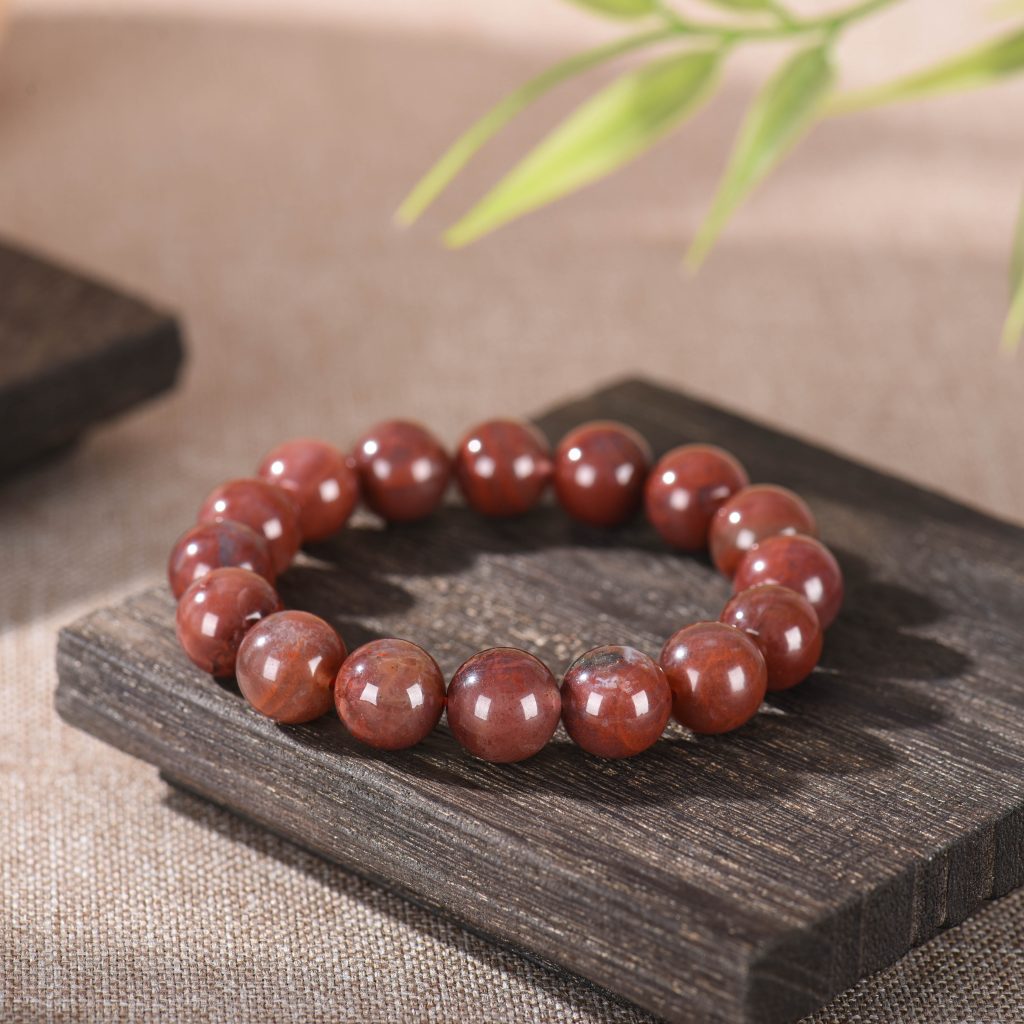
Forever Star Standard: All Forever Star Jewelry nanhong agate is 100% natural, untreated Kazakhstan primary ore. Each piece includes NGTC certification confirming no dyeing, no heat treatment, no resin injection.
Section 2: Common Nanhong Treatments Exposed
2.1 Heat Treatment (热处理)
What It Is:
Heating nanhong agate to temperatures between 140°C – 360°C to alter or enhance color.
How It Works:
The scientific principle behind heat treatment involves mineral transformation:
- Starting Material: Goethite (FeO(OH)) — brownish-yellow iron oxide
- Heat Application: 140-360°C in controlled environment
- Chemical Reaction: Goethite dehydrates, converting to Hematite (Fe₂O₃) — red iron oxide
- Result: Brownish-yellow stone becomes reddish
GIA Research Breakthrough:
In Spring 2021, GIA published groundbreaking research on treated nanhong agate, including detailed analysis of heat treatment effects.
Key Finding:
Heat-treated nanhong shows distinctive Raman spectroscopy peaks at 660 cm⁻¹ (broad band) — a clear indicator of thermal treatment.
This discovery provides laboratories with a reliable scientific method to detect heat treatment.
Identification Characteristics:
| Test Method | Natural Nanhong | Heat-Treated Nanhong |
|---|---|---|
| Color Distribution | Natural variation, gradients | Uniform, saturated |
| Surface Texture | Oily luster, natural | May show fine crazing (crackling) |
| Raman Spectrum | No 660 cm⁻¹ peak | 660 cm⁻¹ broad band present |
| Crystallinity | Higher order | Lower order (disordered) |
Value Impact: -30-50%
A natural nanhong worth $1,000 becomes worth $500-700 after heat treatment disclosure.
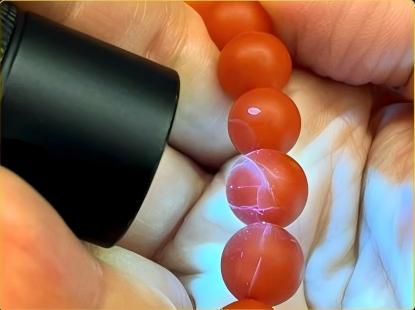
2.2 Dyeing (染色处理)
What It Is:
Immersing nanhong agate in chemical dye solutions, often under heat and pressure, to add or enhance red coloration.
How It Works:
- Preparation: Stone is cleaned and sometimes pre-heated to open pores
- Dye Immersion: Submerged in red dye solution (organic or inorganic compounds)
- Penetration: Heat and pressure force dye into surface-reaching fractures and pores
- Fixation: Dye is chemically or thermally set to prevent immediate fading
Identification Characteristics:
| Test Method | Natural Nanhong | Dyed Nanhong |
|---|---|---|
| Visual Inspection | Natural color variation | Uniform, saturated color |
| Magnification | Diffuse iron oxide clouds | Dye concentration in cracks (darker along fissures) |
| Color Tone | Natural red spectrum (palace, cherry, rose) | Unnatural tones (pink, purple, neon red) |
| Wear Test | Stable indefinitely | May fade, bleed onto skin |
Simple Home Test:
Rub the stone gently with a white cotton cloth soaked in acetone (nail polish remover). Dyed stone may show color transfer.
Caution: This test is somewhat destructive. Only perform on rough or inconspicuous areas.
Value Impact: -70-90%
A natural nanhong worth $1,000 becomes worth $100-300 after dyeing disclosure.
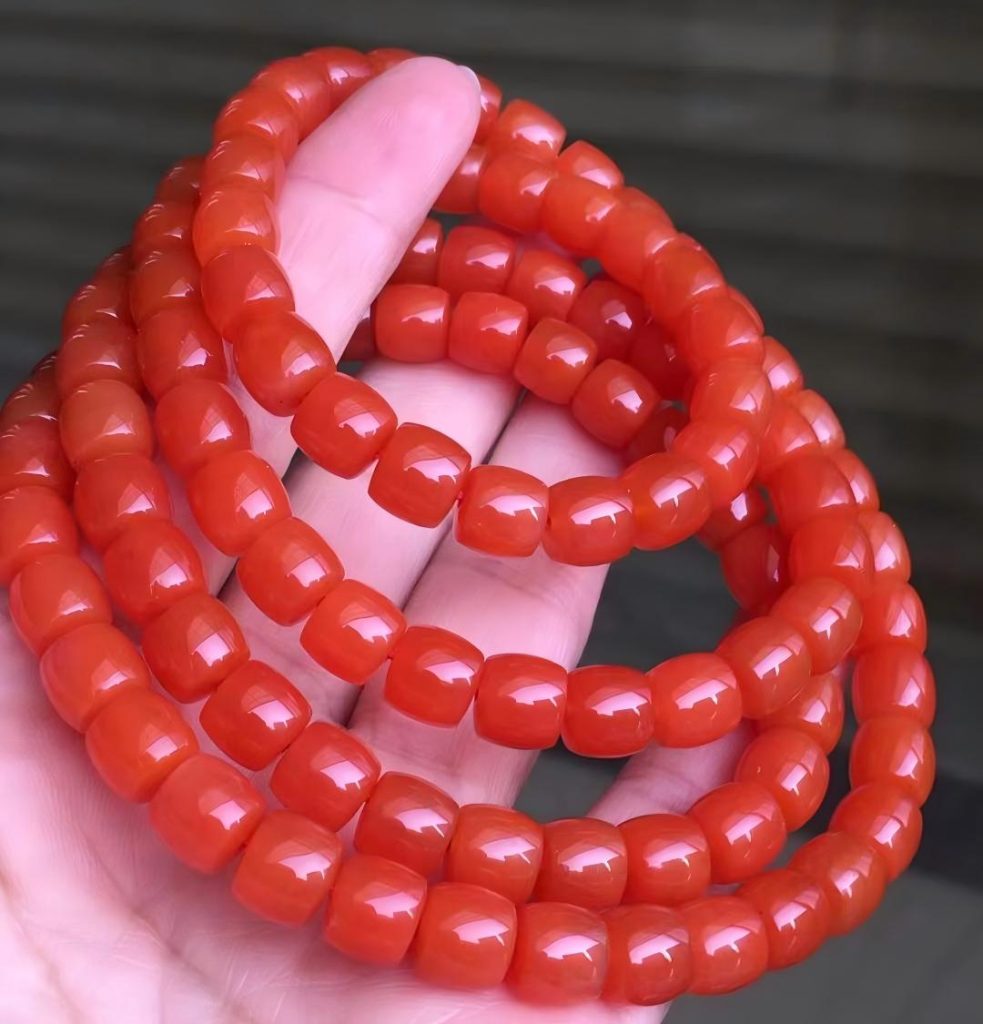
2.3 Resin Injection (注胶处理)
What It Is:
Injecting polymer resins into fractures and pores of low-quality nanhong to improve clarity, stability, and appearance.
How It Works:
- Preparation: Stone is cleaned and dried
- Vacuum Chamber: Air is removed from fractures under vacuum
- Resin Injection: Liquid polymer resin is forced into evacuated spaces
- Curing: Resin is hardened through heat or UV light
- Finishing: Surface is polished to remove excess resin
Why It’s Done:
- Improves apparent clarity (fills visible fractures)
- Increases structural stability (prevents breakage)
- Enhances luster (resin has higher refractive index than quartz)
- Allows low-grade material to be used in jewelry
Identification Characteristics:
| Test Method | Natural Nanhong | Resin-Injected Nanhong |
|---|---|---|
| Visual Luster | Oily, waxy sheen | Overly glossy, glassy |
| Magnification | Natural cryptocrystalline structure | Bubbles, flow structures in filled areas |
| Temperature | Cool initially, gradual warming | Warms quickly (resin has lower thermal conductivity) |
| UV Light | Usually inert | May show fluorescence (resin glows) |
| Hot Needle Test | No odor | Chemical/plastic odor (not recommended for finished pieces) |
Value Impact: -50-70%
A natural nanhong worth $1,000 becomes worth $300-500 after resin injection disclosure.
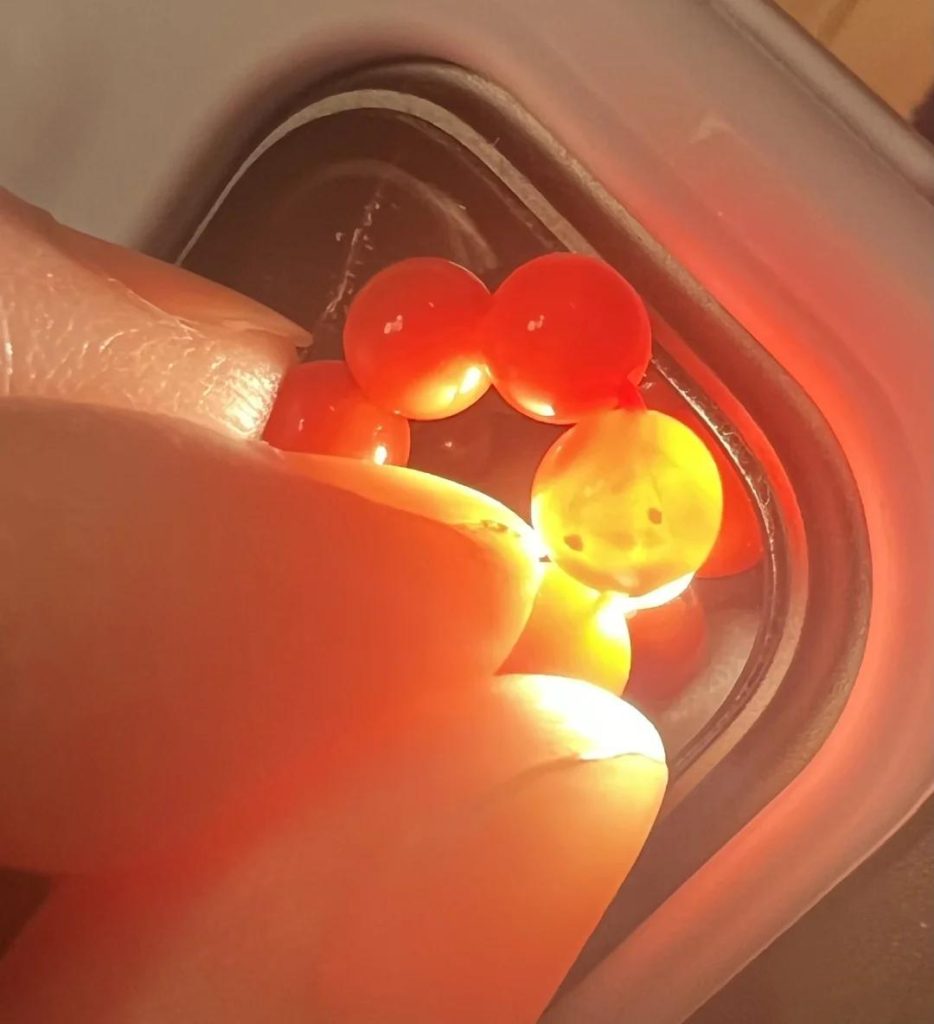
2.4 Acid Washing (酸洗处理)
What It Is:
Treating nanhong agate with acid solutions to remove surface impurities, lighten base color, and improve apparent clarity.
How It Works:
- Acid Immersion: Stone is submerged in dilute acid (often hydrochloric or sulfuric acid)
- Surface Etching: Acid dissolves surface minerals and impurities
- Rinsing: Stone is thoroughly washed to remove acid residue
- Polishing: Surface is repolished to restore luster
Why It’s Done:
- Removes dark surface stains
- Lightens muddy or grayish base color
- Creates cleaner, more uniform appearance
- Relatively low-cost treatment
Identification Characteristics:
| Test Method | Natural Nanhong | Acid-Washed Nanhong |
|---|---|---|
| Surface Texture | Natural mineral grain | Etched or pitted surface |
| Appearance | Natural variation | Unusually “clean” or uniform |
| Magnification | Natural surface features | Surface corrosion patterns |
| Luster | Oily, warm | May appear dull or “stripped” |
Value Impact: -20-40%
A natural nanhong worth $1,000 becomes worth $600-800 after acid washing disclosure.
Section 3: GIA Research Breakthrough — The Scientific Method
3.1 The “Meng Liao” Agate Case Study
Case Background:
In October 2020, GIA’s Carlsbad laboratory received a faceted agate specimen for identification.
Specimen Details:
- Weight: 5.74 carats
- Cut: Faceted (unusual for agate, typically cut en cabochon)
- Appearance: Attractive reddish-orange color
- Seller’s Claim: “New type of Shi Zi Hong (Persimmon Red) nanhong agate”
Initial Observations:
Standard gemological testing revealed:
| Property | Result |
|---|---|
| Refractive Index | 1.54 (consistent with quartz/chalcedony) |
| Specific Gravity | 2.65 (consistent with agate) |
| UV Fluorescence | Inert (no reaction) |
| Microscopy | Cryptocrystalline structure, red dot-like inclusions |
Initial Conclusion: Material was consistent with nanhong agate.
The Critical Question: Was the red coloration natural or treated?
3.2 Raman Spectroscopy Analysis
What is Raman Spectroscopy?
Raman spectroscopy is a non-destructive analytical technique that uses laser light to identify molecular structures based on their vibrational signatures.
How It Works:
- Laser Illumination: Sample is illuminated with monochromatic laser light
- Light Scattering: Molecules scatter light at characteristic frequencies
- Spectrum Analysis: Scattered light is analyzed to create a “molecular fingerprint”
- Identification: Spectrum is compared to known reference materials
Why It’s Powerful:
- Non-destructive (doesn’t damage the specimen)
- Highly specific (can distinguish between similar minerals)
- Sensitive (detects minor components and structural changes)
GIA’s Analysis:
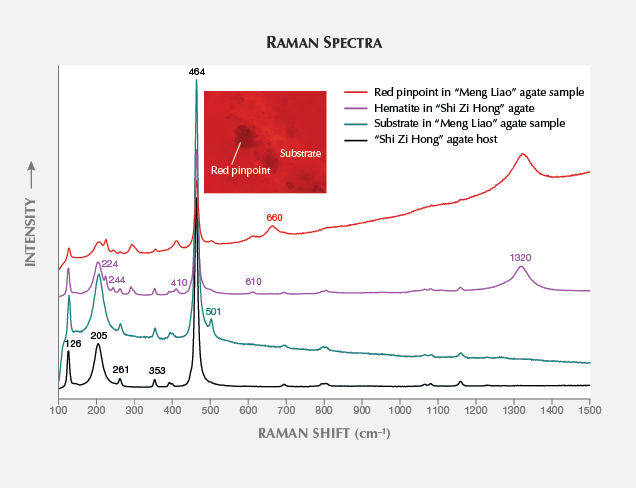
The “Meng Liao” agate underwent Raman spectroscopy analysis with the following results:
Base Material Spectrum:
- Peaks at 126, 205, 261, 353, 464 cm⁻¹ → Quartz (SiO₂) ✓
Red Inclusion Spectrum:
- Peaks at 224, 244, 291, 410, 610, 1320 cm⁻¹ → Hematite (Fe₂O₃) ✓
Unexpected Findings:
- Peak at 501 cm⁻¹ → Cristobalite (high-temperature silica polymorph)
- Broad band at 660 cm⁻¹ → Disordered hematite structure (heat treatment indicator)
3.3 The Smoking Gun: 660 cm⁻¹ Peak
What Does the 660 cm⁻¹ Peak Mean?
According to GIA’s research, referencing academic studies by Zhou Dan-yi et al. (2016) and de Faria & Lopes (2007):
Natural Hematite:
- Forms over millions of years through geological processes
- Highly ordered crystalline structure
- 660 cm⁻¹ peak is very weak or absent
Heat-Treated Hematite:
- Forms rapidly when goethite is heated to 140-360°C
- Disordered, less crystalline structure
- 660 cm⁻¹ broad band is clearly present
The Science:
When goethite (FeO(OH)) is heated, it dehydrates to form hematite (Fe₂O₃):
2 FeO(OH) → Fe₂O₃ + H₂O
(Goethite)    (Hematite)  (Water vapor)
This rapid transformation doesn’t allow time for ordered crystal growth, resulting in a disordered hematite structure that produces the distinctive 660 cm⁻¹ Raman band.
3.4 Cristobalite and Crystallinity
The 501 cm⁻¹ Peak:
The presence of cristobalite (a high-temperature silica polymorph) provided additional evidence of heat treatment.
Research Finding:
Zhou Dan-yi et al. (2016) found an inverse relationship between cristobalite content and crystallinity in nanhong agate:
- Higher cristobalite content → Lower crystallinity → Heat treatment likely
- Lower cristobalite content → Higher crystallinity → Natural formation
GIA’s Conclusion:
“The presence of the 660 cm⁻¹ band, combined with the 501 cm⁻¹ cristobalite peak, provides strong evidence that this material has undergone heat treatment.”
The “Meng Liao” agate was disclosed as heat-treated nanhong agate, not natural.
https://www.gia.edu/doc/Spring-2021-Gems-Gemology-v2.pdf
The “Meng Liao” agate: 5.74 carats, heat-treated nanhong. GIA Spring 2021 case study. Photo credit: GIA. -(99、100、101 page)
Section 4: 7 Methods to Identify Treated Nanhong Agate
Method 1: Color Observation (Home Test)
What You Need:
- Good natural lighting or daylight-equivalent lamp
- White background (paper or cloth)
- Comparison pieces (if available)
Procedure:
- Place the stone on white background
- Observe under consistent lighting
- Look for color distribution patterns
- Compare multiple pieces side by side
Natural Nanhong:
- Multiple red tones within single piece (gradients from deep crimson to lighter orange-red)
- Soft, organic color boundaries (feathered transitions)
- Characteristic red spectrum (palace, cherry, rose, persimmon, ox blood)
- Each piece is unique
Treated Nanhong:
- Uniform, saturated color across entire piece
- Sharp, defined color boundaries
- Unnatural color tones (bright pink, purple, neon red)
- Multiple pieces look identical (batch processing)
Reliability: ★★★☆☆ (Good indicator, but not definitive)
Method 2: Magnification Inspection (Home/Professional)
What You Need:
- 10x loupe (minimum)
- 30x-60x microscope (preferred)
- Bright, diffused lighting
What to Look For:
Natural Nanhong:
- Fine cryptocrystalline quartz structure
- “Sugary” or “granular” appearance at higher magnification
- Diffuse clouds of iron oxide particles
- Natural inclusions (tiny mineral crystals, fluid inclusions)
Dyed Nanhong:
- Dye concentration along fractures (darker color in cracks)
- Web-like or branching patterns of concentrated color
Resin-Injected Nanhong:
- Glassy or plastic-looking areas within fractures
- Bubbles or flow structures in filled areas
Heat-Treated Nanhong:
- Surface crazing (fine crackling from thermal stress)
- Altered luster (may appear “cooked” or dull)
Reliability: ★★★★☆ (Very good indicator)
Method 3: Temperature Test (Home Test)
Procedure:
- Let stone acclimate to room temperature for 30 minutes
- Touch stone to cheek or inner wrist
- Note initial temperature sensation
- Hold stone in palm for 60 seconds
- Observe warming rate
Natural Nanhong: Cool to initial touch, gradual warming over 30-60 seconds
Treated/Imitation Nanhong: Warms almost immediately
Reliability: ★★★☆☆
Method 4: Hardness Verification (Use Caution)
Natural nanhong agate ranks 6.5-7 on the Mohs hardness scale.
Procedure: Hold knife at 45° angle, apply moderate pressure, drag across surface
Expected Results:
- Natural nanhong: No visible scratch
- Softer materials/treated stone: Visible groove or scratch
Reliability: ★★★★☆ (Potentially destructive)
Method 5: UV Light Test (Requires Equipment)
Natural Nanhong: Usually inert (no reaction)
Resin-Injected Nanhong: May show blue or white fluorescence
Reliability: ★★☆☆☆
Method 6: Raman Spectroscopy (Laboratory Test)
What It Detects:
- 660 cm⁻¹ (broad band) → Heat treatment
- 501 cm⁻¹ → Cristobalite (low crystallinity)
- Organic peaks → Dye/resin
Where to Get Tested: NGTC, GIA, AGL, regional certified labs
Cost: $50-200
Reliability: ★★★★★
Method 7: Certification Verification (Gold Standard)
What Reputable Certificates Include:
- Identification: “Nanhong Agate”
- Treatment Disclosure: “Natural” or “No indication of treatment”
- Origin Statement
- Weight and Measurements
- Security Features (holograms, QR codes)
Recognized Laboratories:
- NGTC — China’s most authoritative
- GIA — International standard
- Gubelin, SSEF, AGL — Luxury/rare gemstones
Reliability: ★★★★★
Section 5: Value Impact — How Treatment Affects Price
5.1 Price Comparison (2026 Market)
8mm Bead Prices:
| Treatment Type | Value Retention | Price per Strand (36 beads) |
|---|---|---|
| Natural AAA | 100% | $14,400-43,200 |
| Natural AA | 80-90% | $2,880-7,920 |
| Natural A | 60-70% | $540-1,620 |
| Heat Treated | 50-70% | $1,440-5,400 |
| Resin Injected | 30-50% | $900-3,600 |
| Dyed | 10-30% | $180-1,080 |
Key Observations:
- AAA grade natural commands 8-15x A grade pricing
- Treated material loses 50-90% of value
- Price gap is widening
5.2 Long-Term Value Retention
Natural Nanhong:
- Stable indefinitely
- Appreciates 10-20% annually for AAA grade (2020-2026)
- Auction market recognition
Treated Nanhong:
- May degrade over time
- Depreciates
- Limited resale market
Case Study: 5-Year Value Comparison
- Strand A (Natural AA, $2,500 in 2020): Now worth $4,000-4,500 (+60-80%)
- Strand B (Treated AA, $1,200 in 2020): Now worth $600-800 (-33-50%)
- Net Difference: $3,200-3,900 in favor of natural
Section 6: The Forever Star Standard
6.1 Quality Commitment
100% Natural Guarantee:
✅ No dyeing
✅ No heat treatment
✅ No resin injection
✅ No acid washing
✅ Physical processing only
Certification Included:
- NGTC certificate with every piece over $50
- Online verification
- Full traceability
6.2 Kazakhstan Primary Ore Advantage
- Primary ore deposits
- High gem-grade ratio (15-20%)
- Rare varieties abundant
- Consistent quality
6.3 Inventory (April 2026)
- 300+ finished pieces
- 47 AAA grade flame pattern pieces
- 100 tons raw ore reserve
Section 7: Buyer’s Checklist
Pre-Purchase Questions
- ❓ Is this natural or treated?
- ❓ What type of treatment?
- ❓ Can you provide NGTC/GIA certification?
- ❓ What’s the origin?
- ❓ What’s your return policy?
Red Flags
❌ Prices significantly below market rate
❌ Refusal to provide certification
❌ Multiple pieces look identical
❌ No return policy
❌ Vague or evasive answers
Recommended Practices
✅ Request certification (NGTC/GIA for $500+)
✅ Choose reputable dealers
✅ Learn basic identification
✅ Start with lower prices
✅ Keep all documentation
FAQ
Q1: Is all treated nanhong agate worthless?
No, but it has significantly lower value (10-70% of natural). The key is disclosure.
Q2: Can treatment be detected without laboratory equipment?
Some treatments can be identified with simple methods. Heat treatment often requires Raman spectroscopy.
Q3: Does NGTC certification detect all treatments?
NGTC can detect most common treatments (dyeing, heat, resin). Certification is the most reliable verification method.
Q4: Why is heat treatment common?
It converts brownish-yellow goethite to red hematite, improving color. Reduces value by 30-50%.
Q5: How long does treated nanhong last?
Dyed may fade. Resin-injected can degrade. Heat-treated is stable but may show crazing. Natural is stable indefinitely.
Q6: Can treated nanhong be re-certified as natural?
No. Treatment is permanent.
Q7: What’s the safest way to buy?
Purchase from reputable dealers with NGTC/GIA certification and return policies.
Conclusion: Why Natural Matters
Key Takeaways:
- Value difference is enormous — Natural nanhong is worth 5-10x more
- GIA research provides scientific detection — Raman spectroscopy (660 cm⁻¹ peak)
- Long-term stability — Natural remains stable indefinitely
- Investment protection — Only natural maintains and appreciates in value
- Certification is essential — NGTC/GIA is the only reliable proof
For Buyers:
Whether you’re buying for personal enjoyment, jewelry design, or investment, insist on 100% natural, untreated nanhong agate with NGTC certification.
Forever Star Jewelry stands behind every piece with:
- ✅ 100% natural guarantee
- ✅ NGTC certification included
- ✅ 30-day examination period
- ✅ Full refund if not satisfied
References
- GIA Spring 2021 GemNews — “An Unusual Treated Agate”: https://www.gia.edu/gems-gemology/spring-21-gemnews-an-unusual-treated-agate
- NGTC — Certificate verification: https://www.ngtc.com.cn/
- Zhou Dan-yi et al., 2016 — Rock and Mineral Analysis
- de Faria & Lopes, 2007 — Vibrational Spectroscopy
- GIA Gem Encyclopedia — https://www.gia.edu/gem-encyclopedia